
Alan MacFarlane: Rediscovering China in the UK
Information Sources:uk.people.com, China National Tourist Office, London, etc.
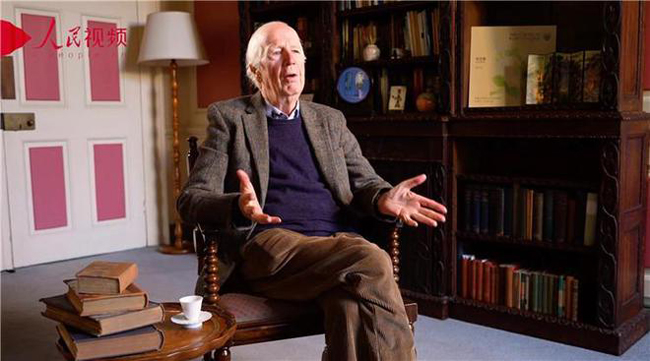
Based on years of research in anthropology and history, Professor Alan MacFarlane, Professor of Social Anthropology at Cambridge University, a Fellow of King's College, Cambridge, a Fellow of the British Academy, and co-founder of Cam Rivers Publishing in the UK, has summarized a set of his own unique comparative research methods to conduct research and practice on different civilizations such as China, Nepal, and Japan.
Over the years, he has not only published a number of influential books in the scientific, humanities and social sciences and art circles, but also co-founded with his colleagues the Cam Rivers Publishing, and participated in organizing many large-scale cultural exchange activities such as the Cambridge Xu Zhimo Poetry and Art Festival and the mutual learning of Chinese and English cultures of Tang Xianzu and Shakespeare, building a bridge between Chinese and English cultures.
After nearly 20 years of research on Chinese civilization, he sincerely expressed his wish to deepen the mutual understanding between Eastern and Western cultures and to realize the lifelong ideal of intermingling and harmonious development of different civilizations.
Meeting China for the First Time, Opening the Door to the "New Century”
It was not until he was 55 that MacFarlane first planned to visit China. In 1996, he spent 10 days in China, and visited Beijing, Xi'an and Guilin, and his first trip to China deeply impressed him.
In 2002, he went to remote villages in China, which was wonderful and meaningful. And in 2003, he went to Wuhan to cross the Yangtze River, and also visited Yunnan and Sichuan, which provided him with more in-depth experiences and feelings, witnessing the great changes that had taken place in China. He has been to China almost every year since then.
As a scholar conducting research on other civilizations, one cannot truly be a Nepalese, Japanese, or Chinese, and the only way to quickly gain a deeper understanding of this civilization is to make more friends and more interactions, treating people with sincerity. His wife kept detailed records in the form of diaries along the way, and he took a lot of video footage. Since 2002, he has taken a large number of video clips of China, which are unique. It took him about ten or fifteen years to begin to really understand China on a deeper level.
When it comes to Chinese friends and impressive places, his mind is flooded with memories. His young and talented students have helped him a lot by explaining to him in detail about China. At the same time, he had the opportunity to meet many Chinese friends who had remarkable and interesting experiences, including some very influential ones.
During his stay in China, he met many senior scholars and was able to interact with leading Chinese educators, historians and political scientists. Many of these friends later came to King's College, Cambridge, and even brought with them performances of Kunqu opera, in addition to academic exchanges with him. He acquainted himself with a wide range of outstanding Chinese artists, from distinguished painters to musicians, in almost every field.
Speaking of his favorite place, he would say that it's like having a big basket of fruit in front of you and not being able to say you only like apples instead of oranges or grapes. China is a diverse country, and that's one of the reasons he fell in love with her. He has been to China 17 times and each time he went there, he had a better understanding of China. There are so many differences in the various local cultures, dialects, etc. in China that one would never get fed up.
Time and time again, he and his wife Sarah visited China, not only because of the fascinating Chinese landscape, food and architecture, but most of all for the people. They found the Chinese to be very warm and welcoming, and his Chinese friends were always attentive and sincere and took special care of them. He met many of his Chinese friends today as early as 20 years ago. The Chinese cherish and maintain direct human feelings, which is what true friendship is all about.
Composing a Concerto on Appreciating Foreign Cultures
MacFarlane believes that many sinologists know far more about China than he does, and his main characteristic lies in the way he studies China. He reckons that China needs to develop anthropology, which happens to be his area of expertise. Anthropology is a discipline that studies human beings and involves all aspects of human life, and it has to be studied in various fields such as politics, economy, and society, and cannot be treated in isolation. It is a comprehensive approach to research, and a comparative one, in which the object of study is often placed in comparison, unlike most other disciplines.
In order to truly understand China, one has to observe the history of China over thousands of years, but one also has to step into modern life, go to cities and villages as well as interact with people, combining the macro view with the micro view, so that one can perhaps claim to start understanding some parts of China. He has a library with thousands of books on China, and he has read almost half of them so far, but he cannot claim to understand China if he only reads books and does not visit the country on a regular basis or without the help of his Chinese friends. This is the reason why many Westerners find it difficult to understand China.
The book China, Japan, Europe and the Anglo-sphere was written between 2017 and 2018, and published in the UK in 2019, and the Chinese version was just released this year, by China Science and Technology Press. The central idea of this book on the comparison of the four major civilizations is that we should try to streamline civilizations and just get to the essence of them.
There are completely different ways of thinking between China and the West, and the task he has recently set for himself and his wife is to try to build a bridge between the two mindsets. It is the mission of anthropology that good anthropologists should both integrate into their own civilization and at the same time be bold enough to cross over, to leave behind prejudices and preconceived notions and become part of another civilization. Without losing the identity of one's own civilization, one must at the same time be open to understanding other civilizations, entering their worlds and discovering the similarities and differences therein.
Therefore, this book builds bridges for the reader mainly through the idea of harmony among civilizations. Like a concerto, the score has different notes, some played by the violin, some by the cello or double bass, and the different instruments keep their own characteristics and work together to make a chord. China has always advocated "harmony in diversity", and he believes that through better understanding, the world will become a more harmonious place.
Working Together to Build a Cultural Bridge between China and the UK
In promoting cross-cultural exchanges, MacFarlane considers it necessary to work on all levels, organizing seminars, summer courses, cultural and art festivals, etc., as well as facilitating through publications. Thus, a few years ago, he and his colleagues co-founded Cam Rivers Publishing, aiming to build a bridge between Chinese and Western cultural exchanges. They publish various books in collaboration with other publishers and are one of the few companies that publish in both China and Western countries.
They set up their own office and bookstore in Cambridge, and they also have colleagues and partners in China, with many collaborative book publishing projects with Chinese publishers such as the Commercial Press of China and the China Science and Technology Press. Through this model of cooperation, they translate Chinese books into English or English books into Chinese, and introduce interesting and meaningful ideas from China to Westerners, as well as bring the best of Western ideas to China. This year, he is also involved in the creation of the Cam Rivers College ---- an international platform for intellectual exchanges and innovation. He hopes that through a multi-faceted model of cooperation, intercultural exchanges and mutual learning can be truly realized.
