
Menerel Chimedtseye: Translating Traditional Chinese Cultural Classics is a Great Fun
Information Sources:Xinhua, People's Daily
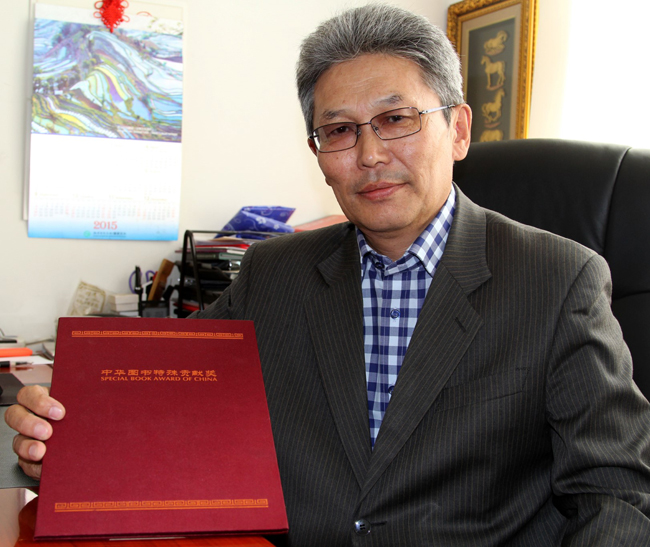
Professor Menerel Chimedtseye is the first Mongolian sinologist and translator to receive the Special Book Award of China. He has compiled the Concise Dictionary of Commonly Used Chinese Characters, the Chinese and Mongolian Tutorials, and published translations of The Analects of Confucius, The Great Learning, Sun Tzu's Art of War, and The Doctrine of the Mean, as well as several books, including What We Know and Don't Know About China: Thinking and Culture, and Selected Short Stories by Modern and Contemporary Chinese Women Writers.
Translating Chinese Classical Works to Make Mongolian People Understand the Essence of Chinese Culture
More than 40 years ago, Chimedtseye studied Chinese language systematically for three years at National University of Mongolia. He found many mysteries in Chinese culture worth exploring, which sowed the seeds for his subsequent dedication to the study of sinology.
After graduating from Beijing Language and Culture University in 1987, Chimedtseye realized that Confucius' doctrine was becoming more and more influential in the world, while it was scarcely studied in Mongolia. Chimedtseye believed that in order to gain a deeper understanding of Chinese culture, it was essential to learn about Confucius. Confucius is one of the most important representatives of traditional Chinese culture, a great philosopher and educator. He was an adept learner, loving learning, emphasizing the need for lifelong learning, and constantly improving and perfecting himself while educating others. Confucius' thought is the treasure of the world's philosophy, and the Mongolian people should not only know Confucius' thought, but also apply the philosophical concepts of benevolence and love in their daily lives. Therefore, he decided to study the thought of Confucius and to translate the works of Confucius.
Over the years, Chimedtseye has devoted himself to the study of Chinese culture and has been actively translating and promoting outstanding Chinese works, contributing to the development of Mongolian education, culture and society with his profound cultural knowledge and wide social influence, as well as gaining fruitful results in the study of Confucius' doctrine. He has translated The Analects of Confucius and The Great Learning into Mongolian, for which he was awarded the "Golden Feather" prize for literature, the highest award for excellence in translation in Mongolia, with only one person receiving the award each year. The Mongolian edition of The Analects of Confucius has become one of the best-selling books in Mongolia today and was reprinted for the fourth time before 2010. Over the past 20 years, Chimedtseye has translated and introduced traditional Chinese cultural classics such as The Doctrine of the Mean, Sun Tzu's Art of War and The Book of Mencius, with the hope of further deepening Mongolian people's understanding of traditional Chinese culture and the doctrine of Confucius.
In addition, Chimedtseye has a very keen interest in traditional Chinese culture. Apart from his weekly classes for his students, he often introduces the thought of Confucius and traditional Chinese culture through various lectures and media.
Enhancing Bicultural Competence, Establishing Bridges of Language, Culture and Friendship
"In the process of my constant study and translation, I have gained a deeper understanding of Chinese culture, which delights me." said Chimedtseye, "My career and life cannot be separated from Chinese language, Chinese culture and Chinese literature. The work of sinology research and Chinese literature translation is as vast as the ocean, and what I have accomplished is just a drop in the sea. I need to keep pushing forward and forward."
After publishing a number of translations, he realized that it was necessary to sort out and extract the essence of traditional Chinese culture and introduce it to his countrymen in plain language. Therefore, he wrote a monograph in Cyrillic Mongolian, What We Know and Don't Know About China: Thinking and Culture, from the perspective of a sinologist. The book analyzes the Chinese people's implicit and benevolent characteristics, and also introduces Chinese food and tea culture, which is well received by readers.
In addition to his translation career, he has also been the head of Chinese language teaching institutions in Mongolia, and has made significant contributions to the promotion of cultural exchanges between China and Mongolia by conducting research on Chinese language teaching in key local universities and primary and secondary schools, and assisting in Chinese language teaching and local teacher training.
Mongolian Chinese language teaching institution has now become a comprehensive institute. It has trained more than 5,000 non-academic students in the field of Chinese language education. Moreover, the institute established the "Mongolian Sinologists Club" in 2010 and published the academic journal Mongolian Sinology Studies in 2014.
"If the Mongolian Chinese language teaching institution is a small tree that grows well, then the friendship between the Chinese and Mongolian people is the fertile soil and sunshine and rain for its growth. The most significant foundation for the development of Sino-Mongolian friendship is to strengthen mutual understanding and friendship between the two countries, and to nurture generations of people who are committed to Sino-Mongolian friendship. It is this glorious mission that overseas Chinese language teaching institutions are charged with." Prof. Chimedtseye stated fondly.
In Mongolia, Chinese language is enjoying increasing popularity and people are becoming more and more interested in Chinese culture. "I am happy to see that a growing number of young people are learning Chinese language and reading Chinese masterpieces, which is the greatest encouragement to us sinology researchers."
